
Breaking the circle
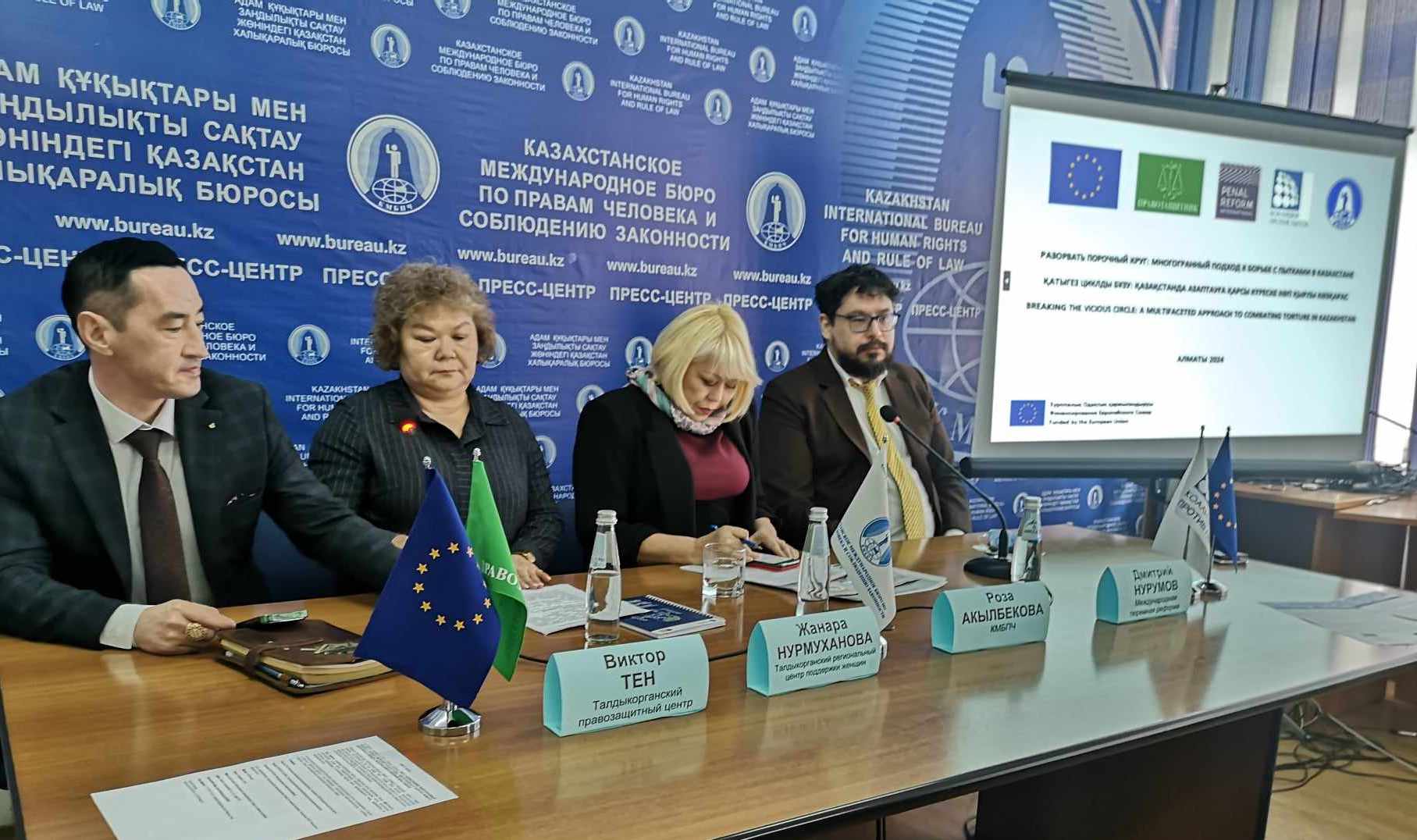
Kazakh human rights activists intend to make another attempt to "break the vicious circle of torture" in connection with the launch of a three-year project funded by the European Union.
This is not to say that the EU's impressive assistance in solving our problem is such good news. First of all, this is an indicator of the scale of the issue. After the January events, Kazakhstan demonstrated that all previous long-term efforts to eliminate torture had come to naught and the republic had taken its place among the odious States where torture was firmly rooted in life.
The Taldykorgan Human Rights Center became the leader of the project, which especially proved itself after the January events. With the support of the NGO Coalition against Torture in Kazakhstan, its staff was able to achieve results in bringing to justice a group of security forces, while in other regions, with the exception of Almaty, all criminals who tortured their victims escaped punishment. Partners in the Coalition against Torture and the representative office of the International Prison Reform (PRI) will also be involved in the implementation of the project.
Dmitry Nurumov, PRI's Regional Program Manager, noted at a press conference after the presentation of the project that torture is inextricably linked to his organization's activities aimed at reforming the penitentiary system and criminal justice in general. After studying specific cases of criminal prosecution for torture and sentencing (in those rare cases when it comes to trial), "weak points" will be identified, on the basis of which recommendations will be developed.
25 years have passed since Kazakhstan joined the UN Convention against Torture. During this time, many things have happened, including the creation of a Coalition of NGOs in Kazakhstan against Torture and the National Preventive Mechanism for the Prevention of Torture, the appearance of the article "Torture" in the Criminal Code, and the opportunity to file individual complaints of torture with the relevant UN Committee, but torture has been and remains. One of the last points is the provision by Kazakhstan of a report on compliance with the Convention against Torture in 2023, where it received over 20 systemic recommendations. Finally, December 8, 2023 marked the appearance of the Human Rights Action Plan, Roza Akylbekova, Deputy Director of the Kazakhstan International Bureau for Human Rights, coordinator of the Coalition, listed the main milestones in the state's relentless and so far unsuccessful struggle against this phenomenon.
"200-250 people apply to our Coalition every year, the last years of 2022-23 show an increase in appeals: in 2022, 190 appeals for January alone and 88 for episodes not related to January, in 2023 – 283 appeals," she cites revealing sad statistics.

Roza Akylbekova also added:
– This year, Kazakhstan will report to the UN Human Rights Council, and civil society is also awake. In April, we must submit the reviews to the UN Council, and the state must report there this fall.
In addition, according to her information, by May 12, the state must provide the UN Committee against Torture with a full plan for the implementation of urgent recommendations concerning the victims of January who went through the crucible of torture.
It is worth noting that the Kantar torture trials initiated by Taldykorgan human rights defenders with the participation of the NGO Coalition of Kazakhstan against Torture are still ongoing in Taldykorgan. There are two policemen in the dock, and nine people are the victims. The Zhetysu Regional court is also considering the issue of compensation for victims of torture who had previously applied to the Taldykorgan City Court, from where they were turned away, Viktor Ten said.
– This is a systematic work of the Coalition, which has been going on all along, and the January events simply exposed some legislative and systemic problems that we have been focusing on. Most likely, the fact that there was a structured approach based on legislative and situational analysis played a role in the fact that the project was supported," concluded Victor Ten.
In Kazakhstan, the crime of torture is related to other articles of the Criminal Code: in addition to "torture" as such, there are "ill-treatment" and "abuse of power." Therefore, the official statistics on those prosecuted for "torture" (Article 146) do not provide an understanding of how many cases are actually hidden behind lighter articles. At the same time, article 146 itself was divided into two parts - "torture", which will be investigated by the prosecutor's office, and "cruel and inhuman treatment", reserved for the Ministry of Internal Affairs, whose employees are most often the beneficiaries of torture. Finally, the presence of penitentiary institutions under the jurisdiction of the Ministry of Internal Affairs in no way contributes to reducing the number of tortures and cases of ill-treatment behind bars, especially in the context of the investigation of torture by internal affairs officers themselves. These points also raise concerns among Kazakhstani human rights defenders.
These concerns will also become the focus of the project's activities. In addition, it is planned to continue providing direct assistance to victims of torture and ill-treatment, and to work in this direction with law enforcement and judicial officials, as well as with the human rights and legal community. Specific results include the development of more effective investigations into cases of torture, improvement of torture prevention mechanisms, proposals for rehabilitation and compensation for victims of torture, and an information and advocacy campaign.
The project is being implemented with the financial support of the Representative Office of the European Union in the Republic of Kazakhstan. The total budget of the three-year project is 768,490 euros, of which the contribution of the European Union is 730,000 euros.