
Prevention, inevitability, and compensation: on obstacles to a torture-free society
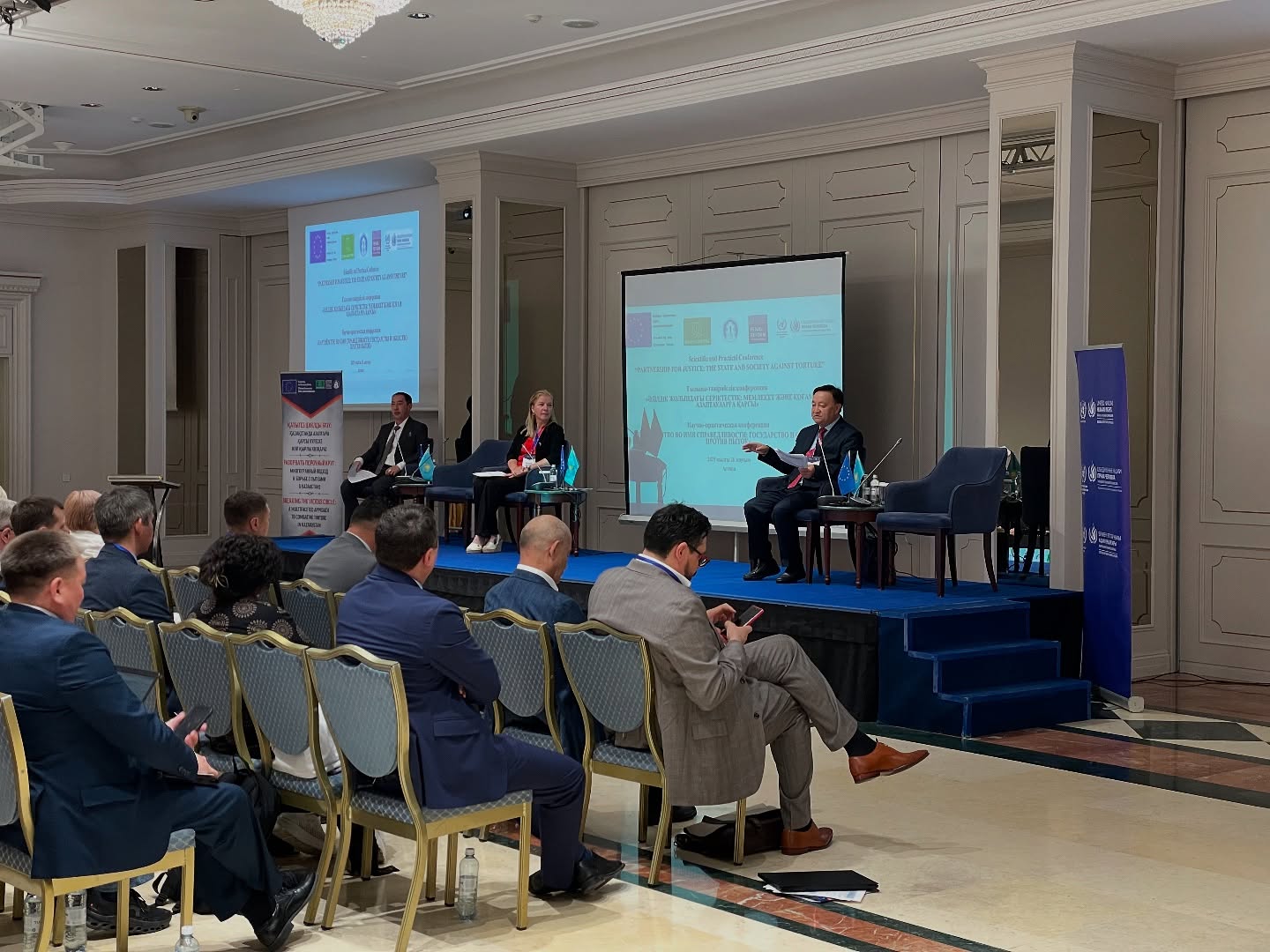
Since 2008, when the authorities of Kazakhstan declared a policy of “zero tolerance” for torture, and up to recent years, when words have gradually begun to turn into action, a small era has passed. At the very least, legislative amendments have been adopted in the country. However, cases of torture and ill-treatment still remain part of our reality — this was discussed in Astana at a conference dedicated to the International Day in Support of Victims of Torture.
On June 26, a scientific and practical conference titled “Partnership for Justice: State and Society Against Torture” was held in Astana. The event was organized within the framework of the project “Breaking the Vicious Circle — A Multifaceted Approach to Combating Torture in Kazakhstan,” supported by the European Union, by the Taldykorgan Human Rights Center, the Penal Reform International office in Central Asia, and the Kazakhstan International Bureau for Human Rights and Rule of Law.
On the Drivers and Obstacles in the Mechanism’s Work
After opening remarks by Aleška Simkič, Head of the European Union Delegation to Kazakhstan, the discussion turned to the achievements and obstacles in the work of the National Preventive Mechanism against Torture (NPM) — currently the most effective instrument due to its established system of visits to closed institutions.
Viktor Ten, head of the Taldykorgan Human Rights Center, reminded participants about the three components of the project running through 2027: prevention of torture, inevitability of punishment, and rehabilitation of torture victims.
“Prevention is better than reacting to something,” said Viktor Zaharia, introducing participants to the activities of the NPM, “which objectively assesses the situation, while the authorities are expected to engage in dialogue, implement NPM recommendations, and jointly take steps to improve the situation.”
Yury Gusakov assessed the work of the NPM over its 11 years of existence.
According to the figures he presented, there were 277 visits to closed institutions in 2014, the first year of operation, and the number subsequently increased. However, a decline became noticeable in 2024. “This is connected to an unclear directive to reduce funding by 10 percent,” the speaker noted, emphasizing that despite access for human rights defenders (except to military barracks, National Security Committee detention centers, and psychiatric institutions), “there is no complaint mechanism in any closed children’s institutions.”
Yury Gusakov divided the development of the NPM into three stages. The initial stage was marked by clear interest and cooperation among all parties; the second, the “pandemic stage,” broke the established system of relations; and now comes the third stage, characterized by a new type of relationship linked to the institution of the Human Rights Commissioner (Ombudsman), due to which “there is now a gradual drift of the NPM toward authoritarianism.”
The next speaker, Rustan Akhmedzhanov, spoke about the further humanization of the penitentiary system (especially for women, juveniles, and vulnerable groups), the development of technical opportunities for prisoners in relation to complaints and communication, and the work of special prosecutors.
He also mentioned an unexpected fact: a new juvenile detention facility is being built in Almaty using investor funds. This is despite the fact that the country currently has only one such institution left in Almaty, which does not suffer from an excess of “guests.”
“As a result of the work carried out, the number of pre-trial investigations into torture cases is decreasing,” he concluded.
The topic of the NPM was continued by human rights defender Tatyana Chernobyl.
In her view, the country needs a separate law on the NPM or, at the very least, as the UN Subcommittee on Prevention of Torture has insisted since 2016, greater independence for the mechanism.
The Subcommittee has repeatedly drawn the government’s attention to the excessive supervisory role of the Human Rights Commissioner, “which may negatively affect the independence of the mechanism,” she explained. Therefore, the Subcommittee recommended strengthening the NPM’s independence from the executive branch by minimizing the role of the Human Rights Commissioner in coordinating and operating the mechanism.
In conclusion, Tatyana Chernobyl reminded participants that the Coalition of NGOs of Kazakhstan Against Torture had drafted its own bill on the NPM, reflecting all recommendations of the Subcommittee, UN treaty bodies, and UN guiding principles.
However, following the latest cycle of the United Nations Universal Periodic Review, for which Kazakhstan reported in January of this year, the country once again refused to accept the recommendation to adopt a separate law on the NPM, arguing that such a law would unnecessarily duplicate previous amendments to other laws (10 laws and 8 by-laws, including those originating from the Ombudsman institution).
Is the Inevitability of Punishment Truly Inevitable?
Said Aimukhan explained how the system should ideally work regarding law enforcement officers accused of torture or other forms of ill-treatment.
According to him, “this year, two torture cases involving penitentiary staff have been registered, while last year there were three,” and 80 percent of those convicted of torture receive real prison sentences.
However, during the discussion, a correction came from the audience: according to the Prosecutor General’s Office, in 2024, 57 cases under the article “torture” were registered in the Unified Register of Pre-Trial Investigations, with 48 recognized victims. Forty-one of those held accountable were representatives of state authorities (primarily the Ministry of Internal Affairs), and four were military personnel.
Human rights defender Yury Gusakov partially confirmed one criticism: “You go to regular-regime colonies — the terminals work. But the terminals in maximum-security sections stop functioning, and then someone comes and reboots them several times.”
Marat Zhusupov, an expert in national legislation and human rights, examined the difference between torture and ill-treatment.
“If the fact of torture is not proven, the case under Article 146 ‘Torture’ is closed, although there may still have been ill-treatment, but such acts remain without procedural assessment,” he said.
While torture cases are investigated by the прокуратура, ill-treatment cases are investigated by the police, despite the often invisible line between the two concepts. “This raises the question: how objectively can they investigate themselves?” Zhusupov added.
Just as Tatyana Chernobyl had earlier argued for a separate law on the NPM, Zhusupov believes the time has come for a separate law on combating torture, which would regulate compensation mechanisms and close other legal gaps.
He also believes that torture victims should be provided with free lawyers and that officers against whom complaints are filed should be suspended from duty.
If punishment for torture is truly inevitable, then attention should return to the events of January 2022 — this proposal was put forward by Anna Raku.
“Questions remain regarding the January 2022 events: the number of victims, the causes of death, and the number of cases closed without trial,” she stated, also confirming that “the NPM should have greater independence and the right to conduct unannounced visits.”
Nevertheless, she noted overall progress, including in comparison with other post-Soviet countries.
“I think that cooperation with non-governmental organizations has already proven its value as a tool for ensuring transparency and trust in the system. Strengthening partnerships is an important condition in the fight against torture, and formats such as joint monitoring, expert councils under state bodies, and participation in preparing reforms create an atmosphere of open dialogue,” she concluded.
In the context of the January 2022 events she mentioned, the testimony of Sayat Adilbekuly from Almaty illustrated the lack of justice, at least in relation to the so-called “Qantar” torture cases.
At the time of his detention, none of the mechanisms described above functioned in practice. In addition to the torture itself, which went unpunished, the judge hearing the accusations against Sayat for participating in riots did not even review the documents properly, while both the duty prosecutor and investigating prosecutor merely demanded that he not speak about the torture inflicted on him and other detainees.
For the damage to his health, psychological trauma, and unlawful detention, the state paid Sayat compensation of 700,000 tenge.
Concluding the discussion on inevitability of punishment, the representative of the Prosecutor General’s Office admitted, in response to a question about whether any torture case had ever been reopened following decisions of the UN Committee Against Torture on individual complaints, that he had never heard of such a case.
The State Is Responsible for Everything
“In the regulatory resolution of the Supreme Court, it is stated that a victim of violence and ill-treatment has the right to compensation from budgetary funds. Other legal acts also state that victims are entitled to compensation, although from the Compensation Fund,” said Yevgeniy Zhovtis, opening the final session. The term “torture,” however, is not explicitly mentioned in these documents.
Returning to the tragic events of 2022, Yevgeniy Zhovtis noted that, according to the courts, torture victims were entitled to compensation only if the perpetrators were identified. However, “under international standards, if harm is caused by the state, then the state compensates for it.”
Roza Akylbekova подробно discussed failures in the compensation system for torture victims.
“In practice, compensation for torture victims is granted rarely, primarily because national legislation rigidly links the right to compensation to the existence of a guilty verdict, which contradicts the position of the UN Committee Against Torture,” she explained.
Even the existence of a conviction does not guarantee victims access to compensation.
On average, victims receive compensation from the Victims’ Compensation Fund amounting to 91,000 tenge, Roza Akylbekova stated.
From 2018 to 2025, according to the Judicial Administration, 827,000 tenge was paid to victims. Only… 9 people were officially recognized as such.
At the same time, from 2022 through May 2025, the Coalition of NGOs of Kazakhstan Against Torture facilitated serious medical assistance for 56 people harmed by state representatives, while another 64 gained access to psychological and psychiatric care — although logically the violator, namely the state, should pay for this.
Finally, the human rights defender noted that according to preliminary findings, most torture cases are terminated “for lack of evidence of a crime,” even despite forensic medical reports, witness testimony, and conclusions prepared under the Istanbul Protocol.
What conclusions can be drawn from the event, which resulted in several dozen more recommendations to the authorities?
Work is being done — there is no question about that. There are still many gaps and shortcomings. Torture, unfortunately, is not yet rare. How strong is the political will of the state? Opinions differ.